A self-guided walk through Old Montréal, from Place d’Armes to the Old Port quays
Old Montréal and the Old Port sit side by side on the St. Lawrence River, and Tourisme Montréal lists a self-guided tour option at several of their landmarks. This route links five stops: Place d’Armes and Notre-Dame Basilica, Pointe-à-Callière, Saint-Paul Street and Marché Bonsecours, City Hall and the Château Ramezay, and the Old Port quays. Each fact comes from Tourisme Montréal pages checked on 13 November 2026.
Stop 1: Place d’Armes and Notre-Dame Basilica
Tourisme Montréal names Place d’Armes as a starting point for exploring Old Montréal and notes that it links directly to the métro; its listing gives Place-d’Armes station. The square dates from the end of the 17th century. Since 1895 a statue of Paul de Chomedey, Sieur de Maisonneuve, the founder of Montréal, has stood in the centre. The Bank of Montreal, founded in 1817, sits on the north side at 119 Saint-Jacques Street West, and the Vieux Séminaire at 130 Notre-Dame Street West, built between 1684 and 1687, is described as the city’s oldest building.
Notre-Dame Basilica, at 110 Notre-Dame Street West, looks down on the square. It was built between 1824 and 1829 in the neo-Gothic Revival style. Inside, a self-guided tour covers 24 points of interest, and the basilica also hosts AURA, a light and sound show.
Stop 2: Pointe-à-Callière, where the city began
Next, walk to Pointe-à-Callière at 350 Place Royale. Tourisme Montréal describes it as a National Historic Site built over the remains of the city’s birthplace, Place Royale, and its Old Montréal article says the museum marks the spot where Montréal was founded in 1642. An archaeological tour runs from Indigenous occupation, through Fort Ville-Marie, the first French establishment, to the present day.
The complex has seven pavilions connected underground. One experience, the Memory Collector, takes visitors into the old collector sewer with images and sound. Pointe-à-Callière lists paid entrance, so check hours and tickets on the museum’s own website before you go. Tourisme Montréal gives Place-d’Armes as the métro station for this stop too.
Stop 3: Saint-Paul Street and Marché Bonsecours
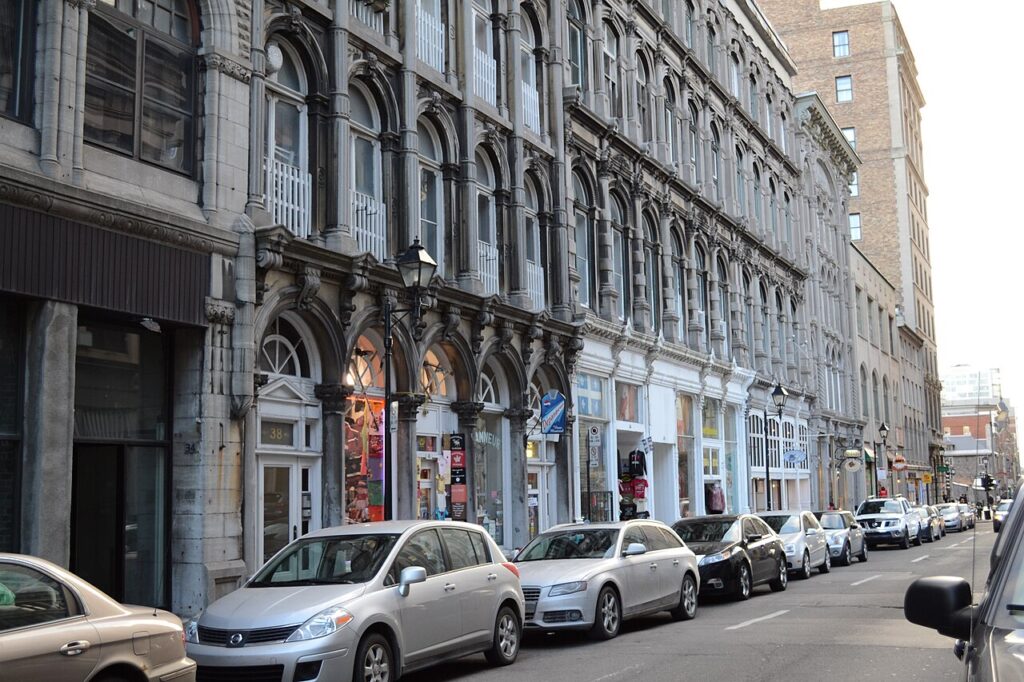
Saint-Paul Street served for years as Montréal’s main street, according to Tourisme Montréal. Many of its 19th century buildings, including former warehouses, have been restored and now hold artisan boutiques, local designer shops, art galleries, restaurants and homes. In summer the street becomes pedestrian-only between rue du Marché-Bonsecours and Saint-Laurent Boulevard. Galleries showing Indigenous and Inuit art include Heritage Gallery at 30 Saint-Paul Street East and Images Boréales at 4 Saint-Paul Street East.
Marché Bonsecours, at 350 Saint-Paul Street East, is the building with the silver dome. Inaugurated in 1847, it was the city’s main agricultural marketplace for over a century, and it also housed a concert hall and even served as a city hall. Today it holds sidewalk cafés, shops for Québec artisans and exhibitions. The Notre-Dame-de-Bon-Secours Chapel stands beside it.
Stop 4: Place Jacques-Cartier, City Hall and the Château Ramezay
Place Jacques-Cartier and Place De La Dauversière have been gathering points for Montréalers for centuries. Tourisme Montréal notes musicians in the first and leafy gardens in the second. The balcony of Montréal City Hall is where General de Gaulle addressed a crowd in 1967 with the words “Vive le Québec libre”, a moment the tourism board marks as an important point in Québec history.
The Château Ramezay, at 280 Notre-Dame Street East, was the first building in Québec to be classified as a historic monument and is the province’s oldest private history museum. Its exhibits cover more than 500 years of history, with a multimedia circuit in six languages and a French Colonial garden. Champ-de-Mars is the métro station Tourisme Montréal lists for both the Château Ramezay and Marché Bonsecours, which makes it a practical exit if you end the walk here.
Stop 5: The Old Port quays and the Jacques-Cartier Bridge
End the walk at the water. Tourisme Montréal lists four places to see the St. Lawrence up close: the Grand Quay of the Port of Montréal, King Edward Quay, Jacques-Cartier Pier and Clock Tower Pier. The Port of Montréal Tower, at 200 De la Commune Street West, reaches 65 metres above the roofline, and La Grande Roue de Montréal, the observation wheel at 362 De la Commune Street East, has heated cars.
Riverside pathways carry joggers and cyclists through the day and strollers after sunset. The Jacques-Cartier Bridge lights up nightly over the river; its colours follow the season and the city’s mood, and an animated sequence plays every 30 minutes. Tourisme Montréal also lists river cruises with AML Cruises and Bateau-Mouche among its Old Port experiences.
The walk in five points
- Start at Place d’Armes, which Tourisme Montréal lists with the Place-d’Armes métro station.
- Notre-Dame Basilica, built from 1824 to 1829, offers a self-guided tour of 24 points of interest.
- Pointe-à-Callière stands over the remains of Place Royale, the city’s birthplace, and lists paid entrance.
- Saint-Paul Street is pedestrian-only in summer between rue du Marché-Bonsecours and Saint-Laurent Boulevard.
- Champ-de-Mars station serves Marché Bonsecours and the Château Ramezay.
Old Montréal walk questions
- Which métro stations work for this Old Montréal walk?
- Tourisme Montréal lists Place-d’Armes station for Place d’Armes, Notre-Dame Basilica and Pointe-à-Callière, and Champ-de-Mars station for Saint-Paul Street, Marché Bonsecours and the Château Ramezay.
- Is Saint-Paul Street closed to cars?
- In summer, Tourisme Montréal says it becomes pedestrian-only between rue du Marché-Bonsecours and Saint-Laurent Boulevard. The page gives no exact dates, so expect traffic outside summer.
- Where can I book a hotel for a walking day in Old Montréal?
- Our Hotel Europa guide and the three Montreal hotels on our home page give addresses and arrival rules. Search them by name on Trip.com to compare rates for your dates.
- Do the museums on this walk charge entry?
- Pointe-à-Callière lists paid entrance, and the Château Ramezay sets its own entrance terms, so check each museum’s website. Place d’Armes and Saint-Paul Street are listed as self-guided tour stops.
Planning a night in Montréal? Compare hotels for your dates.
Compare hotel rates on Trip.comCommission and sources
Sponsored guide. smeasystay.com earns a commission when you book through links on this page, and that affects which hotels we feature and in what order. We do not take bookings. Destination details come from tourism board, park and attraction websites as of 13 November 2026; confirm current rates, fees and cancellation terms on the booking site before you pay.